

-
READ MORE: Declassified CIA book unveils shocking details on how the world may come to an end
From Armageddon to The Day AfterTomorrow, numerous Hollywood films have depicted potential apocalypses for our planet.
However, if a worldwide doomsday scenario were to occur, what could potentially cause the extinction of all life on our planet?
Scientists think they might have found the solution at last, which implies that our end could be quite gruesome.
A recent study conducted by scientists from the Planetary Science Institute and the University of Bordeaux suggests that our planet might be ejected from its orbit due to the gravitational influence of a nearby stellar passerby.
Without our Sun to provide warmth, any residents—including humans—would be left to succumb to the cold and perish.
Fortunately, the odds of this occurring are extremely slim.
In the coming five billion years, the likelihood of Earth having its orbit disrupted by a nearby star is approximately one in 500, as stated by the research team.
The researchers stated in their paper that there is a 0.3% likelihood of Mars being destroyed due to a collision or expulsion, and a 0.2% chance that Earth might experience a similar fate through impact or ejection.
For many years, scientists have wondered
What are possible ways the Earth might come to an end?
.
A drifting black hole, massive asteroid collision, and nuclear warfare might all set off devastating calamities. Additionally, the emergence of autonomous killing machines or the inversion of Earth’s magnetic field could lead to similar outcomes.
In their latest research, which appeared in
arXiv
Nathan Kaib and Sean Reynolds aimed to determine if wandering stars might be responsible for this phenomenon.
“The detailed long-term dynamic fate of the Sun’s planetary system has been simulated and thoroughly analyzed statistically,” they elaborated.
However, much of the previous research treats the solar system as entirely self-contained, ignoring the possible impact of flybys from other stars.
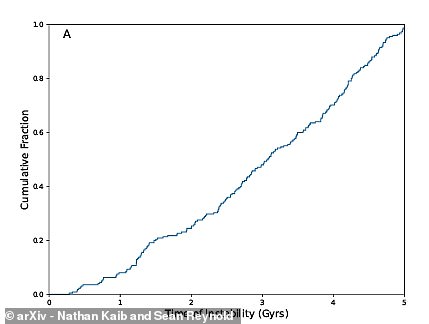
To address this query, they conducted numerous simulations of our solar system over the coming five-billion-year period, taking into account encounters with nearby stars.
Alarming findings from their simulations indicate that our solar system’s eight planets along with the dwarf planet Pluto are considerably less stable than previously believed.
Pluto has the highest likelihood of disappearing due to a collision or expulsion, with the models indicating a 5% probability of such an event occurring.
Mars has a marginally higher probability at 0.3 percent of being ejected from the solar system, whereas Earth faces a 0.2 percent chance.
Regarding the passing stars to watch out for, researchers anticipate that the most hazardous ones will be those that approach within 100 astronomical units of the Sun—significantly closer than Earth’s distance.
Based on the simulations, there’s roughly a five percent probability of such a near miss occurring within the next five billion years.
‘To summarize, wandering stars may disrupt the stability of both planets and Pluto along with changing the long-term structure of the giant planets over the coming 5 billion years,’ the researchers concluded.
‘Their significance on the solar system’s dynamical future largely depends on the strength of the most powerful stellar passage over this time span, which is uncertain by orders of magnitude.
This ambiguity regarding the Sun’s potential future close interactions with other stars indicates that the range of possible long-term evolutionary outcomes and planetary instabilities for our Solar System is wider than what would be suggested by models considering the Solar System in isolation.
Read more