
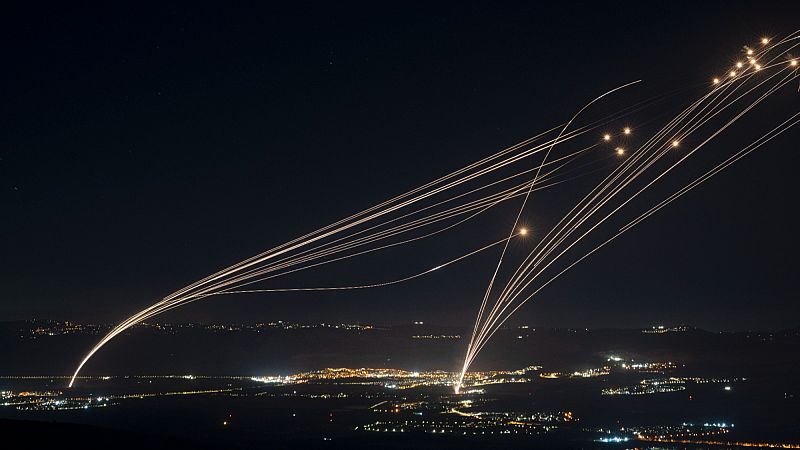
Earlier this week, U.S. President Donald Trump unveiled a proposal for an “American-made Golden Dome” defense mechanism aimed at safeguarding the nation against potential threats from foreign missiles.
Trump says this will be the initial project to have the USA do so.
weapons in space
And it would be up and running by the time he finishes his term in 2029.
Pete Hegseth, the US Secretary of Defense, informed reporters that the Golden Dome represents a “long-term commitment to enhancing America’s security.”
Here’s what we currently understand regarding the Golden Dome initiative, encompassing those involved as well as potential weaponry.
What might the Golden Dome accomplish?
After completion, Trump asserts that the Golden Dome will have the capability to take out incoming threats.
hypersonic
, as well as sophisticated cruise missiles and drones—even if these weapons are deployed from the far end of the globe or from outer space.
Described by Trump as the “best system globally,” the dome reportedly boasts a success rate nearing 100 percent, according to his statement.
A confidential informant informed the Associated Press about the Golden Dome project, which is set to include both terrestrial and orbital components designed to identify and neutralize missiles throughout all four key phases of an assault: initial detection, early-stage intercept during ascent, disruption en route, or prevention upon descent toward their objective.
The US government has also been developing three options, including space-based interceptors, the source said.
A number of initial systems are anticipated to come from current manufacturing lines. During a press briefing earlier this week, senators identified L3Harris Technologies, Lockheed Martin, and RTX (formerly known as Raytheon) as possible suppliers.
In April, L3Harris declared that they had extended their facility in the state of Indiana to focus on “on-orbit technology” for the project known as the Golden Dome.
Lockheed Martin stated on their website that they aim to provide the initial Golden Dome defenses by the conclusion of 2026.
The list includes several current weapons that might be included in the initiative, such as the Command Control Battle Management Communications system (C2BMC). According to the firm, this technology enables commanders to coordinate their choices regarding missile strikes at every stage of the engagement.
Initially, Trump allocated $25 billion (€22.16 billion) for the Golden Dome project within his suggested tax cut legislation. The U.S. House of Representatives endorsed this proposal on Thursday. According to estimates, the complete price tag for the initiative would amount to approximately $175 billion over three fiscal years (equivalent to €155 billion).
On the contrary, a report from the US Congressional Budget Office estimated that the price tag for just the space-based interceptors usable within this system would range from $161 billion (€142.7 billion), which represents the lower-cost choice, up to as much as $542 billion (€480.33 billion) for the higher-cost scenario.
Related
What other places have a layered defense mechanism?
Trump said that the Golden Dome would develop new technologies but would also integrate some that it already has, which could include joint weapons developed with the Israelis for their
layered defense system
.
Frequently referred to as the “Iron Dome,” Israel’s defense mechanism can identify approaching projectiles and will deploy only if the missile is aimed at a populated area or critical military or civilian structures.
Israel employs a mix of the Arrow, David’s Sling, and the Iron Dome systems for defense against long, medium, and short-range missile threats.
The Arrow weapon systems constitute a series of defensive missiles designed for “monitoring, detecting, tracking, and neutralizing” threats before they reach their targets, all managed through an autonomous control system, as stated by the Israel Aerospace Industries (IAI). This project was spearheaded by IAI alongside Boeing from the United States.
David’s Sling, the medium-range defence system created by Israel’s Rafael Advanced Defence Systems along with the US-based RTX, provides “hit-to-kill” protection against ballistic missiles, hostile aircraft, and unmanned aerial vehicles. In contrast, the Iron Dome focuses solely on countering shorter-range threats.
Israeli authorities acknowledge that the system isn’t completely foolproof, yet they commend it for playing an essential part in defending the nation against multiple rocket and missile attacks originating from Iran and militant groups since the start of the Israel-Hamas conflict on October 7, 2023.
Europe is developing its own variant as well. In 2022, 21 European nations initiated the European
“Sky Shield”
The initiative where they committed to work together on the procurement of defense systems, their maintenance, and providing mutual support.
Any weaponry obtained for the Sky Shield will subsequently become part of an ongoing NATO operation aimed at safeguarding Alliance territories from all forms of aerial or missile threats or attacks, as stated by the organization.
Several nations, such as Germany, have entered into agreements with the Israelis or Americans regarding the Arrow missile system as part of Sky Shield.