
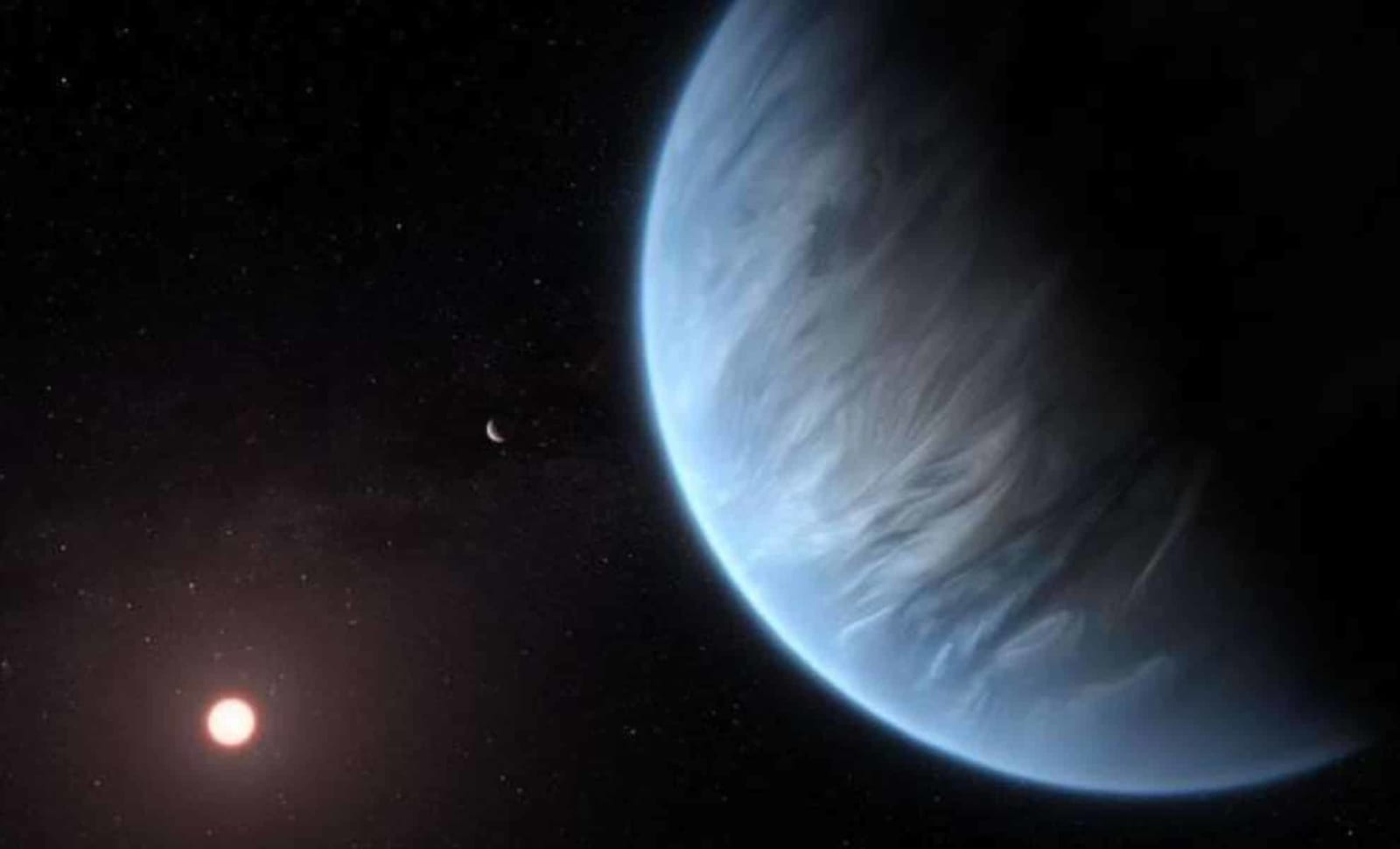
An audacious assertion put forward in April 2025 regarding possible indications of life on an exoplanet.
K2-18b
is now facing criticism following a new scientific assessment. The researchers from
University of Chicago
have reviewed the same atmospheric data again and determined that the evidence suggesting biological molecules might not be as strong as first reported. The initial conclusions were shared by a group from
Cambridge University
, proposed that findings from the
James Webb Space Telescope (JWST)
revealed traces of
dimethyl sulfide (DMS)
or
dimethyl disulfide (DMDS)
—substances found on Earth that are known to come solely from living organisms. However, the latest research, entitled
Insufficient Proof of DMS and DMDS in K2-18b’s Atmosphere
and currently
available on the
arXiv preprint server
cautions against being too certain and contends that the evidence doesn’t back up these strong claims.
Chaotic Information Muddies the Proof
The team at the University of Chicago meticulously analyzed not only the
JWST data
however, along with additional insights provided by other tools such as
NIRISS
,
NIRSpec
,
MIRI
, and even the
Hubble Space Telescope
Their results indicate that the early identification of
dimethyl sulfide
A possible biosignature might stem from overlapping signals caused by more prevalent, non-biological molecules. “The current data we possess is still too cluttered to provide the necessary evidence to support such a claim,” he stated.
Rafael Luque
The study’s lead author and a postdoctoral researcher stated, “There simply isn’t sufficient clarity to draw any conclusions either way.” The paper notes that detecting such subtle atmospheric signals from interstellar distances requires significant assumptions, and the present level of uncertainty is too great to justify getting excited about potential extraterrestrial life.
Ghostly Doppelgangers Debunk the Assertion
A key concern highlighted by the UChicago group is the vagueness intrinsic to spectral analysis. Compounds are distinguished based on their absorption patterns at certain wavelengths; however, numerous substances exhibit comparable spectral characteristics. “Any molecule where carbon connects with three hydrogen atoms appears at a distinct wavelength,”
Luque explained
“That’s the characteristic of dimethyl sulfide. However, numerous other compounds consist of one carbon atom bonded to three hydrogen atoms and would show comparable traits in Webb’s data. Therefore, despite having significantly improved data, it will still be challenging to confirm conclusively whether dimethyl sulfide is indeed what we’re observing.” Some possible alternatives could include:
ethane
, a substance that has already been found in planets such as
Neptune
and
Uranus
—both of which are clearly unsuitable for life. This implies that the spectral signature linked to DMS might just as well originate from a much more common and non-living material.
A Somber Wake-Up Call in the Quest for Life
The study’s creators encourage the scientific community to stay rooted in their analyses, particularly when tackling subjects as intricate and distant as extraterrestrial atmospheres. While hunting for
biosignatures
Playing a crucial role in astrobiology, hasty pronouncements may erode public confidence and diminish scientific integrity. “Determining if there is extraterrestrial life ranks as the foremost query in our discipline. This quest drives each one of us to investigate these distant worlds,”
said Luque
“We are achieving significant advancements in this area, and we wouldn’t want those efforts to be eclipsed by hasty announcements.” The case of
K2-18b
acts as a strong illustration of the capabilities and constraints of contemporary technology. Despite instruments such as JWST being revolutionary, they still face issues with uncertainty and disruption when examining entities situated light-years distant.
Enjoyed this article?
Sign up for our complimentary email bulletin
For captivating tales, special material, and up-to-date information.
To stay updated with similar stories, check out
Nestheo
.