
Kathmandu, May 30 -– In an announcement made today, Deputy Prime Minister and Finance Minister Bishnu Prasad Paudel stated that those found guilty of embezzling cooperative funds will have their passports seized.
On Thursday, presenting the national budget for the fiscal year 2025-26 before a joint meeting of the federal parliament, Paudel disclosed the government’s intention to confiscate the passports of cooperative operators, officials, and those implicated in misusing depositor funds.
He added that the properties belonging to those who are charged will be confiscated and sold at auctions, with the proceeds going into a rotating fund designed to provide compensation for the victims’ families.
The proposed fiscal budget includes the creation of a Cooperative Loan Recovery Tribunal (CLRT). Additionally, the government intends to categorize, streamline, and introduce comprehensive changes to reform the cooperative sector.
In January, the government issued an ordinance establishing the National Cooperative Regulatory Authority (NCRA), which took over from the National Cooperative Development Board. Intended to be a robust tool for assisting depositors in recovering funds, the NCRA has been mostly ineffective because the government has not appointed its head more than four months since its creation.
Last month, Arjun Pokhrel, who stepped down as the secretary of the Ministry of Land Management, Cooperatives, and Poverty Alleviation, took up the position of chairperson temporarily until a permanent appointment can be made. After his retirement on April 15, Kedar Nath Sharma, the present secretary of the same ministry, has been handling the responsibilities in an interim capacity. Recently, the government declared a vacant spot for the leader of this authority, along with open slots for two board member roles.
Even though the budget commits to establishing the Tribunal as another means to reclaim cooperative funds, Kashi Raj Dahal, who formerly chaired the Crisis Cooperative Management Committee, stated that this notion isn’t novel. He highlighted that the plan was previously detailed in the Cooperative Act of 2017, with the administration currently moving forward with putting it into practice.
Dahal elucidated the clear distinctions between the functions of the two entities: “The Authority’s role involves registering and overseeing cooperatives, making sure they adhere to legal requirements, whereas the Tribunal will operate akin to a court system, enabling victims to file grievances and pursue justice.”
Yet, he also took issue with the finance minister for the vagueness in the budget address. He pointed out, “Although the administration mentioned seizing the possessions of cooperative managers, they didn’t specify what kinds of properties would be subject to this action. The budget would have been clearer if it had outlined whether, when an operator’s holdings aren’t enough, assets from their relatives might also face seizure.”
Dahal pointed out that although there are legal measures in place for asset seizure, the government failed to seize the chance to clarify how cooperatives would be incorporated into the national economy to boost productivity.
The budget includes provisions for protecting deposits, suggesting that amounts up to Rs500,000 placed in cooperatives would be secured via a Deposit and Credit Protection Fund. Although last year’s budget included a comparable commitment, it wasn’t carried out due to the absence of necessary procedural guidelines.
The spokesman for the Ministry of Land Management, Cooperatives, and Poverty Alleviation, Ganesh Prasad Bhatta, has shown confidence that this year’s declaration will indeed come to fruition.
“The earlier agreement couldn’t materialize because of insufficient working procedures. However, this time around, setting up a revolving fund offers a transparent process for reimbursing those who made deposits,” he explained.
Moreover, the financial plan includes strategies for digitalizing the procedures of pledging and releasing collaterals in banks, financial organizations, and credit unions with the objective of boosting effectiveness via a unified system.
It is estimated that approximately 3 million individuals are affiliated with more than 34,000 cooperatives nationwide.
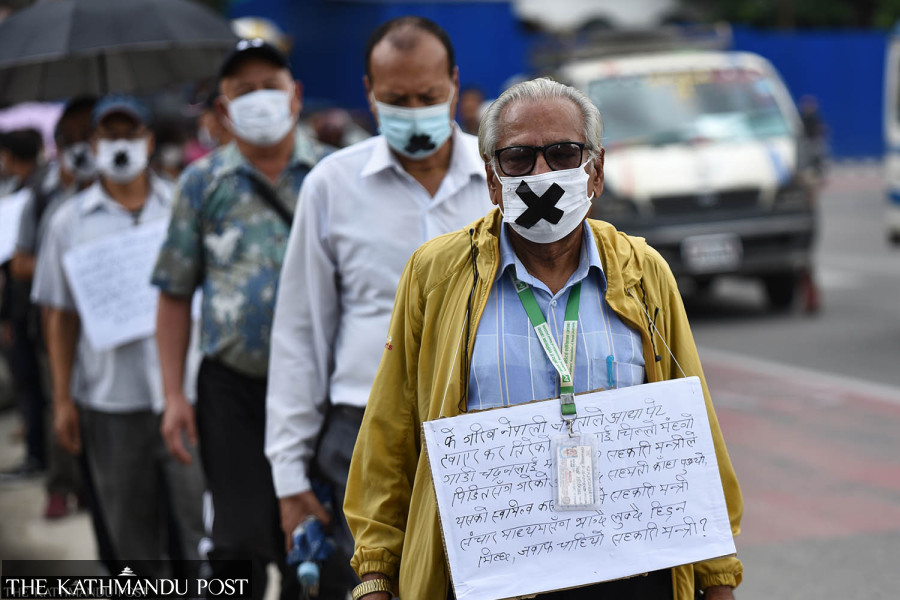
Numerous cooperative members affected nationwide have established protest groups and have been conducting demonstrations over the last few years, demanding the return of funds they had deposited into these cooperatives.
Madhav Shrestha, who is 44 years old and a victimized depositor at the Uttam Cooperative located in Kapan, Kathmandu, believes that implementing provisions like the CLRT and the revolving fund outlined in the government’s budget for cooperatives could be seen as a beneficial move forward.
Shrestha notes that last year too, the government incorporated praiseworthy elements into the budget; however, these measures were not put into practice.
“This time as well, we cannot afford to get overly enthusiastic just because of the budget announcement. The crucial part is how it will be implemented,” he stated.
A significant number of individuals have submitted grievances across multiple regions, and law enforcement agencies have brought charges against numerous persons, including Rastriya Swatantra Party leader and ex-home minister Rabi Lamichhane, for allegedly misappropriating cooperative resources.